


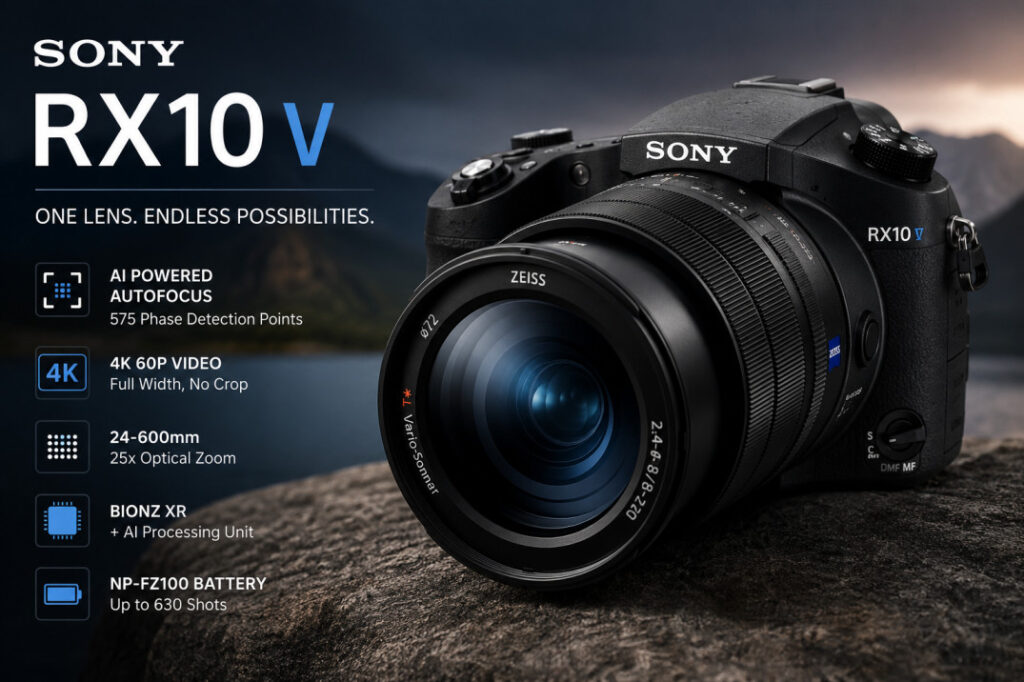
After keeping camera lovers waiting for almost a decade, Sony has finally pulled the curtain back on its latest all-in-one superzoom camera. The Sony RX10 V was officially announced on July 9, 2026, and honestly, this launch feels like a long overdue gift for travel photographers, wildlife shooters, and content creators who never wanted to carry a bag full of lenses.
If you have followed the RX10 series before, you already know why this matters. The previous model, the RX10 IV, came out way back in 2017. Nine years is a lifetime in camera technology, so expectations around the Sony RX10 V were understandably sky high. Let us break down whether Sony has delivered.
In case you missed it — we announced the all-new Sony RX10 V today. 🔭
Built with a fixed 24–600mm lens, AI-powered autofocus, 30 fps blackout-free shooting in one compact, travel-ready camera.
Learn more and pre-order now: https://t.co/9wLRXxdoZf#SonyAlpha #SonyRX10V pic.twitter.com/2SwT7ZvQDe— Sony | Alpha (@SonyAlpha) July 9, 2026
What Makes the Sony RX10 V Special
At its core, the Sony RX10 V keeps the formula that made this camera series a cult favorite in the first place: one body, one lens, and zero lens-changing hassle. The camera comes fitted with the same trusted ZEISS Vario-Sonnar T* lens offering a massive 24-600mm zoom range, which works out to a 25x optical zoom. Whether you are shooting a bird sitting far away on a tree branch or a wide street scene while traveling, this single lens covers almost every situation.
What has genuinely changed is everything happening inside the body. Sony has fitted the Sony RX10 V with a fresh 20.1-megapixel stacked 1-inch Exmor RS CMOS sensor, paired with the newer BIONZ XR processor and an AI processing chip borrowed directly from Sony’s Alpha mirrorless camera lineup. This is a big deal because it brings professional-grade autofocus technology into what is essentially a point-and-shoot style camera.
24-600mm* ズームレンズ搭載、AIによる被写体認識AFと高速性能を備えた
レンズ一体型カメラ『RX10 V』登場
* 35mm判画角相当の焦点距離イメージですhttps://t.co/gKTqpohYm7#rx10v#SonyRX#妥協なき一台とどこへでも pic.twitter.com/LOJNbTfElA— Sony | Alpha (Japan) (@AlphabySony_JP) July 9, 2026
Sony RX10 V Price and Availability
Here is the information most buyers are actually searching for. The Sony RX10 V is priced at $2,299.99 in the US and $2,899.99 in Canada. The camera is expected to hit store shelves from August 2026 onward, with pre-orders already open in several markets. Indian pricing has not been officially confirmed by Sony yet, but based on past currency conversion and import duty patterns for the RX10 series, buyers in India can expect the camera to be priced somewhere close to the premium mirrorless camera segment once it lands locally.
For readers tracking gold and market trends on our site, this launch is a good reminder of how currency movement affects imported gadget pricing too. You can check our detailed coverage on gold price trends in India to understand how the rupee-dollar equation influences the cost of imported electronics like cameras.
Autofocus Upgrade: The Real Star of the Sony RX10 V
If there is one area where the Sony RX10 V truly leaves its predecessor behind, it is autofocus. Sony has packed in 575 phase-detection autofocus points that cover roughly 70.6 percent of the frame. Combined with AI-powered subject recognition, the camera can now identify and track people, animals, birds, and vehicles with far more confidence than before.
There is also a feature called Human Pose Estimation, which helps the camera keep tracking a person even if their face briefly turns away or gets blocked. For wildlife and sports shooters, this kind of tracking reliability was previously reserved for much more expensive interchangeable lens cameras. Now, the Sony RX10 V brings it into a fixed-lens body.
Video Capabilities of the Sony RX10 V
Video shooters have plenty to be excited about too. The Sony RX10 V can record 4K video at up to 60 frames per second using the full width of the sensor, with no cropping involved. For creators who want extreme slow motion, there is also a 4K 120p mode, though this comes with a slight sensor crop.
Sony has added 10-bit 4:2:2 color recording along with support for S-Cinetone and S-Log3 color profiles. This means vloggers and independent filmmakers get cinema-style color grading flexibility straight out of a compact camera body. The Sony RX10 V also supports importing up to 16 custom LUTs, which is a feature usually found on dedicated cinema cameras rather than superzoom models.
Battery Life and Build Quality
Sony has finally moved the Sony RX10 V to the larger NP-FZ100 battery, the same one used across its Alpha camera range. This upgrade alone brings more than a 50 percent improvement in battery endurance compared to the RX10 IV, with the new model rated for approximately 630 shots per charge using the rear screen.
The camera body has also been redesigned with a more modern control layout, while still retaining dust and moisture resistance. This makes the Sony RX10 V a genuinely practical option for outdoor and travel photography, where unpredictable weather is often part of the deal.
Sony RX10 V vs RX10 IV: Should You Upgrade
For existing RX10 IV owners, the big question is whether this upgrade is worth it. The lens specifications remain nearly identical, so if you already love the zoom range, nothing changes there. But the jump in autofocus intelligence, video quality, and battery life makes the Sony RX10 V a meaningful generational leap rather than a minor refresh.
That said, it is worth remembering that the camera still uses a 1-inch sensor, which is smaller than the APS-C or full-frame sensors found in interchangeable lens cameras at similar price points. Early testing suggests low-light image quality still has some limitations at higher ISO settings. So if you mostly shoot indoors or after dark, this is a tradeoff worth thinking about before spending nearly $2,300 on the Sony RX10 V.
Who Should Buy the Sony RX10 V
This camera is built for a very specific kind of buyer. If you are someone who travels often, shoots wildlife or birds as a hobby, or covers casual sports events without wanting to invest in multiple lenses, the Sony RX10 V makes a strong case for itself. The all-in-one convenience, paired with genuinely upgraded autofocus and video specs, is hard to find anywhere else in this exact category.
For readers wanting to compare official specifications directly, Sony’s own product page carries the full technical breakdown at Sony Electronics’ official RX10 V listing.
Final Thoughts
Nine years is a long wait in the camera world, but based on everything revealed so far, the Sony RX10 V feels like it was worth it. From the AI-driven autofocus system to the significantly improved video capabilities and battery backup, Sony has clearly listened to what long-time fans of this series wanted. Whether it justifies its premium price tag will depend on your personal shooting needs, but there is no denying that the Sony RX10 V has reignited genuine excitement in the bridge camera category.
We will keep tracking official India pricing and availability updates for the Sony RX10 V and update this article as soon as more details are confirmed.
Sources: Sony Electronics official press release, Imaging Resource, DPReview, Newsshooter