
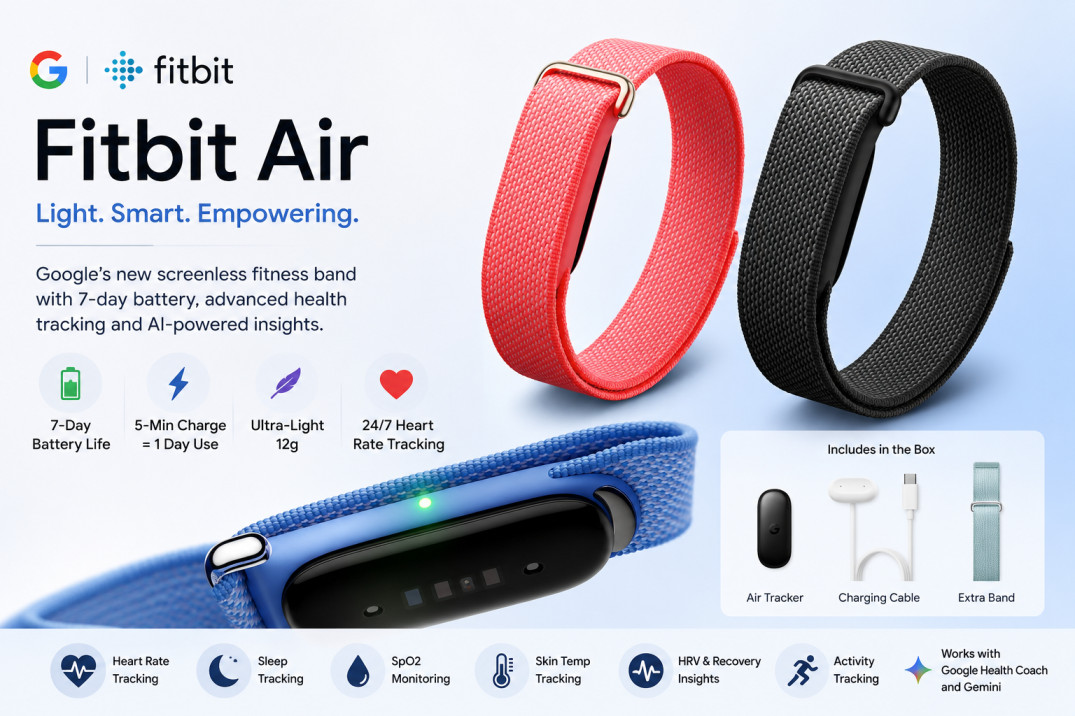
Google has officially unveiled the Google Fitbit Air, a brand-new screenless fitness wearable that could completely reshape the health tracking market in 2026. The company is positioning the device as a lightweight, distraction-free alternative to traditional smartwatches while directly competing with premium recovery wearables like Whoop.
The Google Fitbit Air arrives at a starting price of $99.99 and focuses heavily on passive health tracking, AI-powered wellness insights, and long battery life. Unlike many premium fitness trackers, Google is not locking basic health features behind a subscription paywall, which instantly makes the device stand out in the wearable industry.
This launch is also important because it marks Google’s biggest Fitbit strategy shift since acquiring Fitbit in 2021. Alongside the device, Google confirmed that the Fitbit app will officially become the Google Health app, creating a unified health ecosystem powered by Gemini AI.
If you bought a Whoop, I feel sorry for you.
Google’s Fitbit Air just made it look silly
– $100 one time payment vs Whoop’s $199–$359/year forever
– Free tier actually works HR, sleep, SpO2, HRV, recovery, no paywall
– Optional $10/mo for Gemini Health Coach (vs Whoop where… pic.twitter.com/m3Q9DtXkFZ
— Rjey (@RjeyTech) May 7, 2026
What Is Google Fitbit Air?
The Google Fitbit Air is a minimalist fitness tracker without a screen, notifications, or apps. Instead of behaving like a smartwatch, the device is designed to quietly monitor health data in the background throughout the day and night.
Google says the wearable is built for users who want:
- continuous health tracking
- improved sleep monitoring
- fewer distractions
- lighter wearables
- better battery life
The company describes the product as a “proactive wellness partner” focused on simplicity and comfort.
At just 12 grams, the tracker is one of the lightest wearable devices launched by Google so far. Reports suggest the lightweight design makes it comfortable enough for 24/7 use, especially during sleep tracking.
Google Fitbit Air Features
The Google Fitbit Air includes several advanced health and recovery features despite its tiny form factor.
Key features include:
- 24/7 heart-rate monitoring
- SpO2 blood oxygen tracking
- skin temperature sensing
- HRV monitoring
- sleep stage tracking
- recovery insights
- automatic workout detection
- AFib irregular rhythm alerts
- 7-day battery life
- fast charging support
According to Google, just a five-minute charge can provide nearly a full day of battery life.
The wearable also supports more than 140 workout types and works on both Android and iPhone devices.
Google has officially announced Fitbit Air, a screenless fitness band similar to Whoop 🚨
– 24/7 heart rate tracking
– SpO2, skin temperature & recovery insights
– Up to 7 days battery life
– Swappable bands
– No mandatory subscription for core features
– Works with Google’s… pic.twitter.com/Q1guFQk0mZ— Shishir (@ShishirShelke1) May 7, 2026
Google Health App and Gemini AI
One of the biggest reasons the Google Fitbit Air is attracting attention is its AI integration.
Google confirmed that the Fitbit app is being replaced by the Google Health app starting May 26. The new platform combines Fitbit tracking with Gemini-powered coaching and personalized health recommendations.
Users can subscribe to Google Health Premium for $9.99 per month to unlock advanced AI-powered coaching features.
The Gemini-based Health Coach can reportedly:
- analyze recovery trends
- recommend workouts
- explain sleep patterns
- monitor stress changes
- provide wellness guidance
- generate personalized fitness plans
Google says the system uses fitness, sleep, nutrition, and health data to deliver smarter recommendations over time.
This move signals Google’s transition from simple activity tracking toward a full AI health ecosystem.
Why Google Fitbit Air Is a Direct Whoop Competitor
The Google Fitbit Air is being compared heavily with Whoop because both products focus on recovery tracking instead of smartwatch functionality.
However, Google is taking a very different approach.
Whoop requires an ongoing membership fee that can cost users hundreds of dollars yearly. In contrast, Google is offering core tracking features for free after purchasing the device.
That pricing strategy could attract:
- casual fitness users
- gym enthusiasts
- runners
- sleep tracking users
- people tired of smartwatch distractions
Google also has one major advantage: ecosystem integration.
The Google Fitbit Air works alongside:
- Pixel Watch
- Android devices
- Google Health app
- Gemini AI services
Users can even switch between Pixel Watch and Fitbit Air without losing tracking continuity.
Google just released the Fitbit Air for just $99
> Just 12 grams
> No mandatory subscription
> 7 day battery life
> 5 minute charge gives full day of use
> 24/7 heart rate tracking
> Swappable bands
> Connects with Google Health Coach and Gemini ($10 optional subscription)
>… pic.twitter.com/YGlBvUWE4Y— Noah Cat (@Cartidise) May 8, 2026
Fitbit Air Price and Availability
The Fitbit Air price starts at $99.99 in the United States. Google has already opened pre-orders, while shipping begins on May 26, 2026.
Google is also launching special edition bands, including a Stephen Curry edition priced at $129.99.
As of now, there is no official India launch date for the Google Fitbit Air, but reports suggest the company may expand availability soon because Google Health Coach has already launched in India.
Google is also expanding its AI ecosystem across devices and wearables. Recently, reports about the upcoming iPhone 18 Pro leaks revealed how major tech companies are now focusing heavily on AI-powered hardware experiences.
Final Verdict
The Google Fitbit Air could become one of the most important wearable launches of 2026.
Instead of trying to compete with premium smartwatches directly, Google is focusing on:
- simplicity
- AI-powered wellness
- passive tracking
- lightweight design
- affordable pricing
If the device delivers strong real-world accuracy and useful Gemini coaching, the Google Fitbit Air could seriously challenge Whoop and even change how consumers think about health wearables.
Google is no longer just making fitness trackers. It is building an AI-powered health ecosystem.