
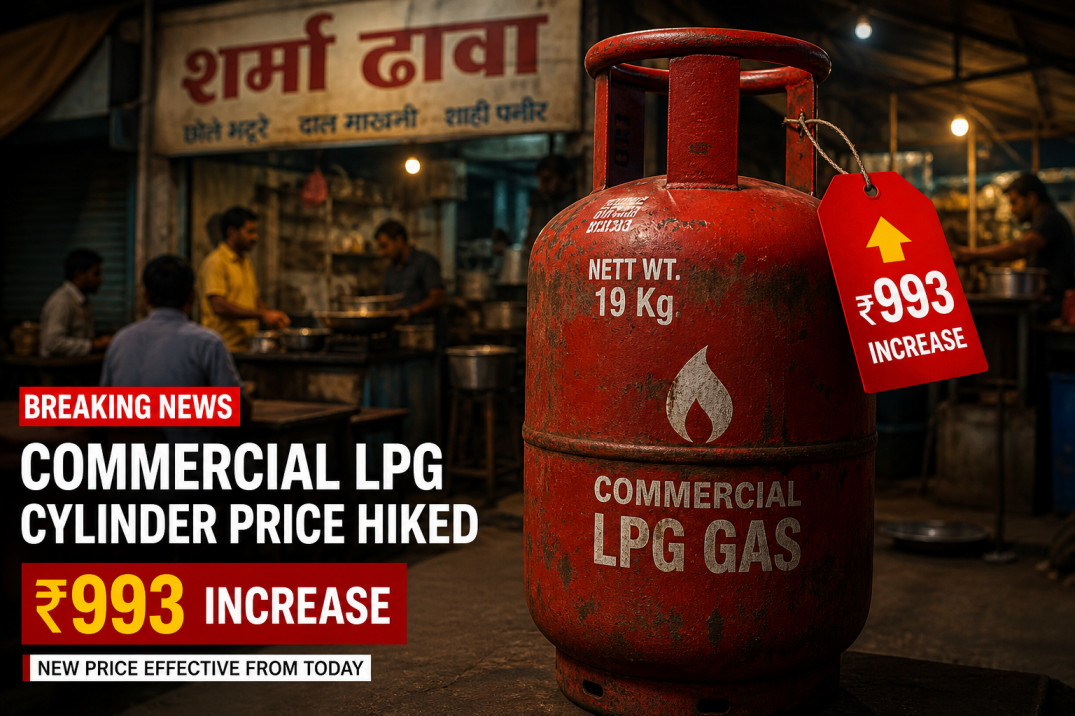
The commercial LPG cylinder price hike May 2026 has sent a shock across India’s small business economy. On May 1, 2026, the government raised the price of the 19 kg commercial cylinder by a record ₹993 in a single day – one of the steepest single-day increases in the country’s history. While household domestic cylinder prices remained untouched, millions of small business owners – from roadside dhabas and tea stalls to hotel kitchens and bakeries – are now staring at a massive jump in operating costs.
Prices of 19 KG Commercial cylinder has been increased by Rs 993 from today. A 19 Kg cylinder will cost Rs 3071.50 in Delhi from today. No change in domestic cylinder prices: Sources
— ANI (@ANI) May 1, 2026
Commercial LPG Cylinder Price Hike May 2026: What Are the New Rates?
Effective May 1, 2026, the revised price of a 19 kg commercial LPG cylinder in Delhi stands at ₹3,071.50, up from ₹2,078.50 last month. Mumbai sees the new rate at ₹3,024, while Bengaluru consumers will pay ₹3,152 per cylinder. The hike of ₹993 applies uniformly across all cities, though the final retail price varies slightly by location due to local taxes and transport costs.
- Delhi ₹3,071 – 19 kg cylinder
- Mumbai ₹3,024 -19 kg cylinder
- Bengaluru ₹3,152 -19 kg cylinder
- Hike amount ₹993 – from Apr 2026
The 5 kg Free Trade LPG (FTL) cylinder — widely used by street vendors and small tea stalls — also saw a ₹261 increase, adding to the financial pressure on the most vulnerable businesses in India’s informal food economy.
Prices of Commercial LPG cylinders, used by industries and hotels, are deregulated, market determined and revised normally on a monthly basis. Their consumption is less than 10% of the total LPG consumed in the country.
April 1 price increase in Commercial cylinder price is due…
— Ministry of Petroleum and Natural Gas #MoPNG (@PetroleumMin) April 1, 2026
the commercial LPG cylinder price hike May 2026 is directly linked to…”
The government and oil marketing companies have pointed to a volatile global energy market as the primary driver behind the price revision. India imports a significant share of its LPG requirements, and domestic commercial prices are revised every month based on international benchmarks, crude oil prices, and currency exchange rates.
According to reports, Brent crude prices touched $126 per barrel on Thursday before slightly easing to $113 per barrel on Friday. The spike has been triggered by escalating geopolitical tensions in West Asia, particularly involving the US, Iran, and Israel, and disruptions to shipping through the Strait of Hormuz — one of the world’s most critical oil and gas supply routes. When global energy costs rise this sharply, Indian oil marketing companies absorb significant losses, or “under-recoveries,” which can exceed ₹380 per cylinder.
The Ministry of Petroleum and Natural Gas has clarified that commercial LPG prices are entirely deregulated and market-determined, unlike domestic cylinders which are subsidised for household use. Commercial consumption accounts for less than 10 percent of total LPG used in the country, which is why the government chose to pass on the global cost shock to this segment while keeping household prices stable.
Domestic cylinder prices – no change for now
For the approximately 33 crore households who depend on the 14.2 kg domestic LPG cylinder, there is no immediate impact. The price continues to hold at ₹913 in Delhi. The last domestic price revision was on March 7, 2026, when rates rose by ₹60 per cylinder. Oil marketing companies have confirmed that domestic prices will remain unchanged for now, offering temporary relief to families already managing tight household budgets.
Who will be hit hardest?
The immediate victims of this price hike are India’s vast informal food economy. Roadside dhabas, tea stalls, small restaurants, bakeries, and sweet shops depend almost entirely on commercial LPG to run their kitchens. Unlike large restaurant chains with the capacity to absorb short-term cost increases, most small vendors operate on extremely tight margins. A single 19 kg cylinder that was available for ₹2,078.50 last month now costs ₹3,071.50 — a jump that directly eats into daily profits.
For many vendors, a single cylinder lasts only a few days depending on the volume of business. This means the extra cost will recur every few days, making it nearly impossible to absorb without passing it on to customers. However, the typical customer at a roadside eatery is often a daily wage worker or a lower-income individual — someone equally hit by inflation and in no position to pay more for a plate of food or a cup of chai.
Industry experts have warned that in the coming weeks, food prices at street-level eateries and budget restaurants are likely to increase. Hotels and catering businesses face similar pressure, and the downstream effect on food inflation could be significant if global energy prices remain elevated.
#WATCH | Lucknow | On commercial LPG cylinder price hike, Samajwadi Party chief Akhilesh Yadav says, “With the increase in the price of cylinders, not only do they become expensive, but food, drinks, and bread also start getting expensive. Just wait and see what other things will… pic.twitter.com/5eBbcFzzCg
— ANI (@ANI) May 1, 2026
Political reactions: Opposition calls it an “election bill”
opposition leaders slammed the commercial LPG cylinder price hike May 2026…”The price hike has triggered sharp political reactions. Leader of the Opposition Rahul Gandhi took to social media to call the development the “election bill,” alleging that fuel prices had been artificially held down during the Assembly elections in several states and were now being corrected. He pointed out that from February to May 2026, commercial LPG prices had risen by ₹1,380 — a cumulative jump of approximately 81 percent in just three months.
Samajwadi Party chief Akhilesh Yadav warned that the price hike would have a cascading effect on food, drinking water, and daily essentials. Karnataka Deputy Chief Minister D.K. Shivakumar, speaking from Bengaluru, said the hike would directly hurt both common citizens and the hotel industry, accusing the ruling BJP of betraying voters after the elections concluded.
AAP leader Atishi also criticised the move sharply, calling it a “return gift” from the ruling party to voters. Punjab Minister Balbir Singh said prices at tea stalls, samosa counters, and small food shops would all go up as a result, and demanded the government roll back the decision or face protests from workers on International Labour Day.
Will prices rise further? commercial LPG cylinder price hike May 2026
the commercial LPG cylinder price hike May 2026 marks the third consecutive monthly increase…”
Oil marketing companies revise LPG prices on the first day of every month based on global benchmarks. The May 2026 hike is the third consecutive monthly increase for commercial cylinders. Analysts warn that if the West Asia conflict continues to destabilise supply chains, prices could remain elevated through the summer months. There is also concern that prolonged global instability could eventually force the government to revise domestic cylinder prices as well, particularly if under-recoveries on oil company books continue to mount.
The upcoming foldable phones launching in 2026 segment is getting more competitive as Motorola prepares the Razr 2026.
For now, the government has chosen a calibrated approach – shielding 33 crore domestic consumers while aligning commercial prices with market realities. But for the millions of small business owners who keep India’s street food economy running, the month of May has begun with an unwelcome and heavy burden.