
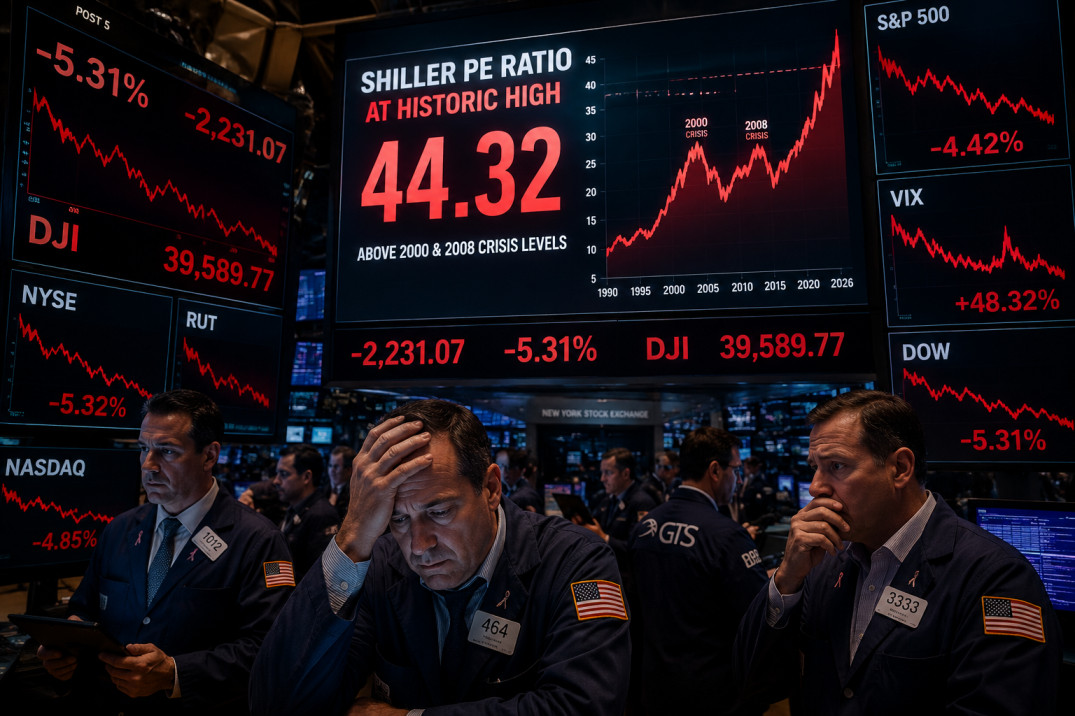
Fresh fears of a possible Stock Market Crash are spreading across Wall Street after the famous Shiller PE ratio climbed close to levels previously seen before the dot-com crash and the 2008 financial crisis. Investors across the world are now questioning whether the US stock market is becoming dangerously overvalued again.
The discussion became viral after investor Ankit Yadav shared a post on X claiming that the current Shiller PE ratio has crossed levels seen during major historical market crashes. The post quickly attracted attention from retail investors, traders, and financial analysts.
This latest Stock Market Crash warning comes at a time when technology and artificial intelligence stocks have already surged sharply over the past year.
URGENT STOCK MARKET FORECAST
Both the Korean and American stock markets are confirmed bearish now. The trend change is confirmed.Even if we break all time highs again, we’re still bearish. This means that we can still go up two or three percent but any millisecond now, the… pic.twitter.com/LvavciYJDA
— Wall Street NYC Quant. bitcoin-fund-manager.com (@BITCOINFUNDMGR) May 18, 2026
What Is the Shiller PE Ratio?
The Shiller PE ratio, also known as the CAPE ratio, is a long-term stock market valuation tool created by economist Robert Shiller. It compares current market prices with inflation-adjusted average earnings over the last ten years.
Current Market Price
Shiller PE = ——————————————————
Average Inflation-Adjusted Earnings Over 10 Years
Historically, when the Shiller PE ratio reached extremely high levels, the market later experienced sharp corrections. During the dot-com bubble in 2000, the ratio crossed 44 before the S&P 500 eventually crashed nearly 49%.
Because of this history, many analysts consider the Shiller PE ratio an important signal for possible Stock Market Crash risks.
Why Investors Are Suddenly Worried
Over the last year, the US stock market has been heavily driven by artificial intelligence companies, semiconductor firms, and major technology stocks. Investors poured massive amounts of money into AI-related shares, pushing the Nasdaq and S&P 500 to record highs.
However, experts now believe stock valuations may have moved too far ahead of actual earnings growth. According to recent reports, the S&P 500 CAPE ratio is trading near dot-com era levels.
This has increased fears that even a small economic slowdown could trigger a broader Stock Market Crash or a significant correction in overvalued sectors.
Rising Bond Yields Add More Pressure
Another major concern for investors is the rise in US Treasury bond yields. Higher bond yields often make stocks less attractive because investors can earn safer returns through bonds.
Recent reports suggest Wall Street could face a “meaningful correction” if yields continue climbing.
Analysts believe higher inflation, geopolitical tensions, and strong oil prices are increasing pressure on financial markets. This environment has made the current Stock Market Crash discussion even stronger among traders.
AI Stocks Could Face Bigger Volatility
Several market experts have warned that AI stocks may be entering bubble territory. Technology investor Dan Niles recently predicted that some AI-related companies could eventually see sharp declines if investor excitement slows down.
Many analysts now compare the current AI boom with the internet bubble of the late 1990s. During that period, investors aggressively bought technology stocks before the market eventually collapsed.
Although AI remains one of the fastest-growing industries, experts say valuations have become stretched in many companies. That is why the current Stock Market Crash fears are focused mainly on technology shares.
Social Media Is Increasing Fear Among Retail Investors
Financial discussions on social media platforms like X, Reddit, and YouTube are now heavily influencing retail investors. Viral posts predicting a Stock Market Crash often spread quickly and increase panic among traders.
However, experts continue advising investors not to make emotional decisions based only on social media predictions. Markets can remain expensive for long periods before a correction actually happens.
Analysts say long-term investors should focus on diversification, risk management, and quality companies rather than reacting to every viral warning.
Can a Stock Market Crash Really Happen?
No one can accurately predict the exact timing of a market crash. However, analysts agree that extremely high valuations increase long-term risks.
Some experts believe strong corporate earnings and AI-driven innovation may continue supporting the market. Others warn that excessive optimism, rising interest rates, and geopolitical uncertainty could eventually trigger a broader Stock Market Crash.
The next few months will be very important as investors closely monitor inflation data, Federal Reserve policy decisions, and earnings reports from major technology companies.
The growing focus on artificial intelligence is also changing how major tech companies operate globally. Recently, Salesforce CEO Marc Benioff discussed how AI could transform the future of business strategy and digital workspaces. Read more in our detailed report on Marc Benioff’s latest AI strategy here: click here
Conclusion
The latest Stock Market Crash warning linked to the Shiller PE ratio has created fresh uncertainty across global financial markets. While some analysts fear a repeat of past crashes like 2000 and 2008, others believe the current AI-driven growth story may continue supporting stocks for longer.
For now, investors are staying cautious as market volatility increases. Whether this turns into a major Stock Market Crash or only a temporary correction, Wall Street is expected to remain highly sensitive in the coming weeks.